What Can You Do in Xi'an in 3 Days? Terracotta Warriors, City Wall Sunsets and Tang Dynasty Nights (2026)
Published 2026-09-21 · Updated 2026-10-26 · Itineraries
TL;DR
A: Three days is the Xi'an sweet spot if you split it right: Day 1 the Muslim Quarter + Bell and Drum Towers + a sunset bike ride on the Ming city wall; Day 2 the Terracotta Army as a morning day-trip, back for the Big Wild Goose Pagoda fountain show and Tang light-city at night; Day 3 a museum morning (Shaanxi History Museum if you snagged the free ticket — released 5 days ahead at 17:00 sharp — otherwise Xi'an Museum) then Tang Paradise or hanfu portraits. Foreigners can book the warriors with a passport; the wall costs about $8 (¥54) plus $7 for the bike. Skip nothing after dark — Xi'an is a night city.
What’s the short answer?
Xi’an packs 3,000 years into a compact rectangle: a fully intact Ming-dynasty city wall around the old town, the Bell Tower at dead center, the Terracotta Army 40 km east, and a Tang-dynasty-themed light district that only truly exists after dark. Three days works if you respect two rules. First, cluster — never cross the city twice in one day. Second, book ahead — the Terracotta Army, Shaanxi History Museum and the wall’s prime sunset slots all require advance reservation, and the museum’s free tickets vanish in minutes. This route puts you beside the Bell Tower for two nights and does the warriors as a single clean day-trip. Prices below are USD at roughly ¥6.7 = US$1, with the CNY reference in brackets.
Why does this Xi’an route work?
Because it follows the city’s geography instead of zig-zagging between the warriors, the museums and the wall. Most Xi’an first-timers lose a full day zig-zagging between the warriors (far east), the museums (south) and the wall (center). This route follows the city’s geography instead:
- Day 1 stays entirely inside the walled old town: Muslim Quarter lanes, the Bell and Drum Towers, then up onto the wall at Yongningmen for the sunset-to-lights bike circuit.
- Day 2 is the one long move: out to Lintong for the Terracotta Army in the morning (beating the tour buses), back through an afternoon rest, then the Big Wild Goose Pagoda fountain show and the Datang Everbright City at night — they’re 10 minutes apart on foot.
- Day 3 is a museum morning (two free options, one hard to book, one easy) plus the pagoda up close, ending with Tang Paradise gardens or hanfu portraits before your train or flight.
Base yourself near the Bell Tower for all three nights: the Muslim Quarter is at your doorstep, Metro Line 2 runs straight under your hotel to the North Station, and every evening ends with the tower lit above the traffic circle.
Day 1 — What’s inside Xi’an’s old town? (Muslim Quarter, Bell Tower, wall at sunset)
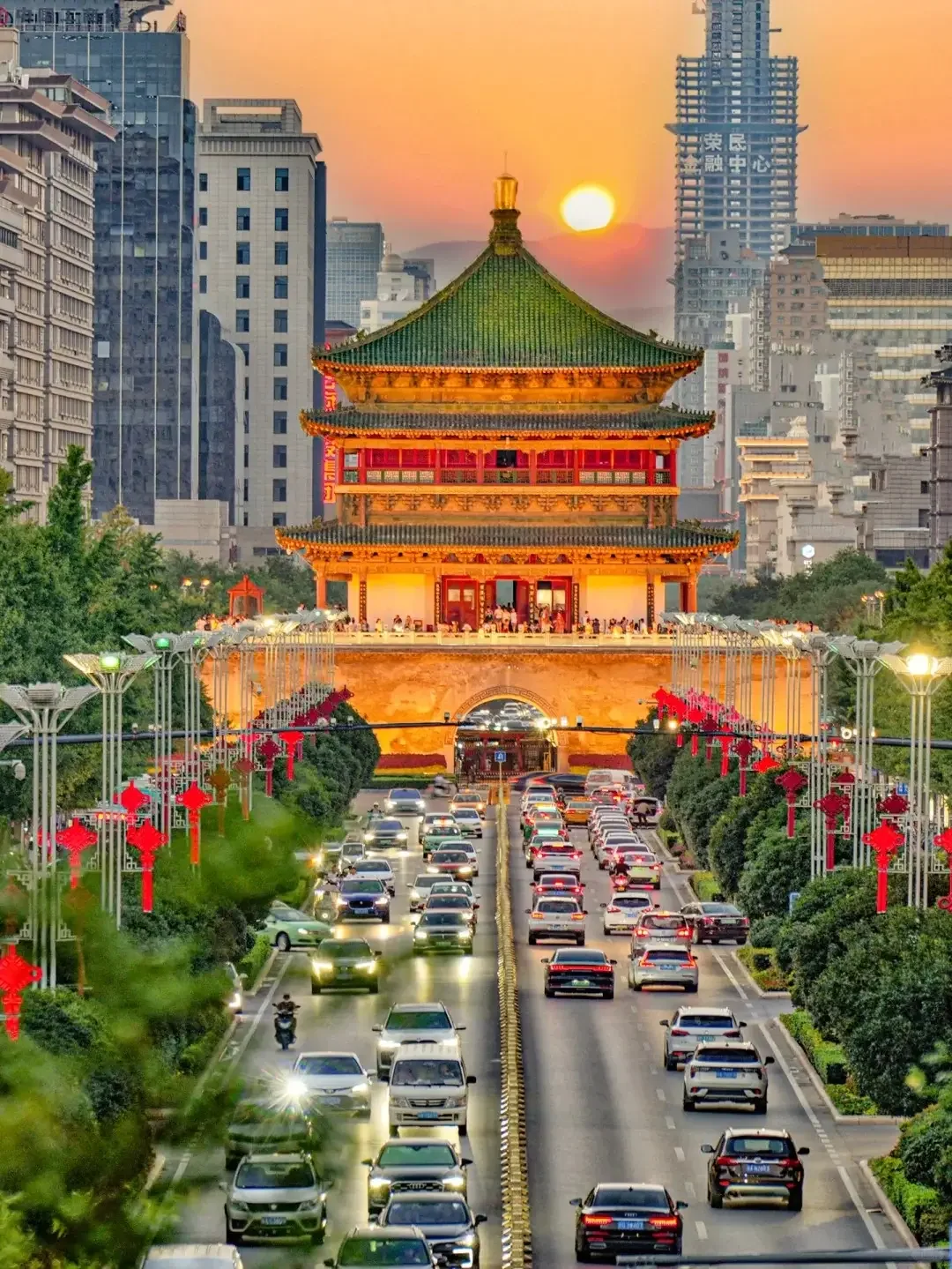
| # | Stop | Cost | Getting there |
|---|---|---|---|
| 1 | Sajinqiao food street (locals’ Muslim Quarter) | Food from ~$0.75 (¥5) | Line 1 Sajinqiao Stn |
| 2 | Guangoxiang lanes | Free | Walk |
| 3 | Drum Tower + Muslim Quarter main street | Tower $7.50 (¥50) combo w/ Bell Tower | Line 2 Zhonglou Stn |
| 4 | Bell Tower exterior at blue hour | Free (viewing) | Zhonglou circle |
| 5 | City wall, Yongningmen (South Gate) | $8 (¥54) + bike $7 (¥45)/3h | Line 2 Yongningmen Stn |
How the day flows: Start hungry at Sajinqiao (洒金桥) — the Muslim Quarter street locals actually eat on (the famous Beiyuanmen strip is the tourist version; see our Xi’an food guide for the stall-by-stall list). Work back through the lanes toward the Drum Tower, buy the ¥50 combo ticket only if you want the museum interiors — the exteriors after dark are the real show, and they’re free. Then the essential Xi’an experience: enter the wall at Yongningmen (永宁门, South Gate) around 90 minutes before sunset, rent a bike, and ride. The full circuit is 13.74 km (about 90–120 minutes); the south and east sections have the best light. You’ll see the sun drop behind the rooftops on one side and the city lights come up on the other. In summer start after 18:00 or the ramparts are a griddle; bring more water than feels reasonable.
Three local shortcuts most visitors miss:
- The wall’s south gate doesn’t close at sunset — it stays open into the evening (typically to 22:00 in peak season; last ticket around an hour before). Confirm that day’s hours on the official WeChat account before you commit.
- Don’t photograph inside the warriors’ pits with flash, and don’t lean over the rails — preservation first, and staff will call it out loudly.
- Book the wall online, not at the gate. Same-day tickets exist, but the sunset-entry window sells out on weekends and holidays; the official mini-program takes passports.
Day 2 — How do you see the Terracotta Army and the Tang light city in one day?
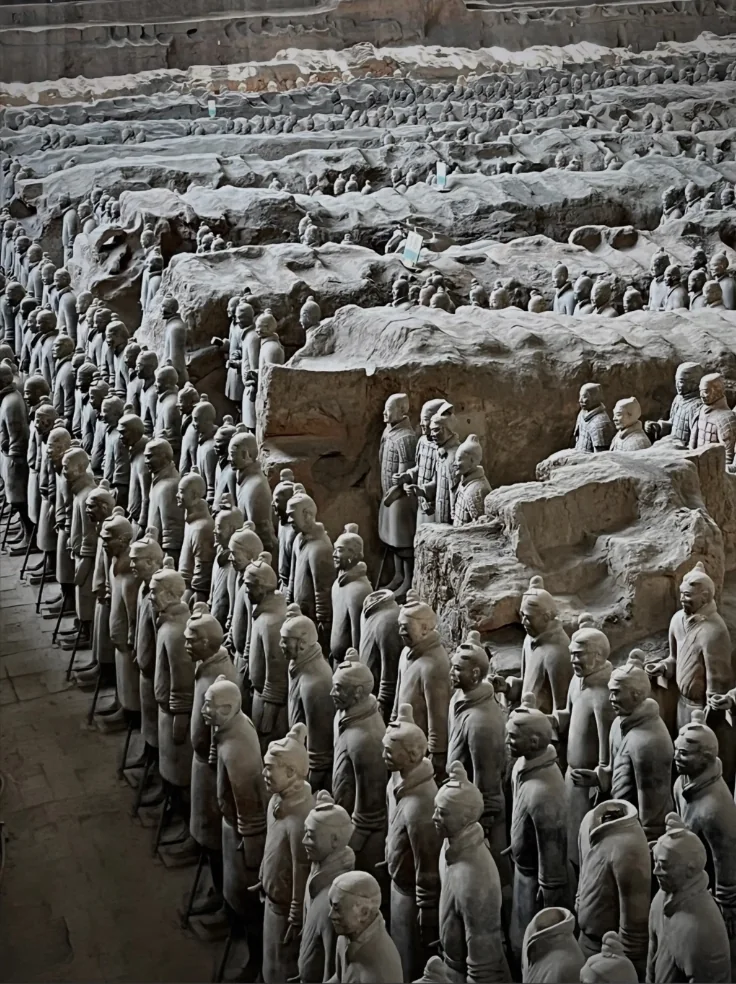
| # | Stop | Cost | Getting there |
|---|---|---|---|
| 1 | Terracotta Army (Emperor Qinshihuang’s Mausoleum Site Museum) | $18 (¥120) | Line 9 to Huaqingchi Stn + bus 602/tourist line 613, or direct tourist bus |
| 2 | (Optional) Huaqing Palace + Song of Everlasting Sorrow show | Palace $18 (¥120); show from $37 (¥249) | Same Line 9 stop, opposite the warriors’ road |
| 3 | Big Wild Goose Pagoda North Square fountain show | Free | Line 3/4 Dayanta Stn |
| 4 | Datang Everbright City (Tang light district) | Free | Walk from the pagoda square |
How the day flows: Take the earliest sensible train — the warriors open around 08:30 and the tour-bus wall hits between 10:00 and 15:00. Foreigners can book online: use the museum’s official site or mini-program with your passport number, then enter on the passport itself (see the FAQ below for the walkthrough). Budget 3–4 hours: Pit 1 (the football-field-sized hall you know from photos), Pit 3 (the command post), Pit 2 (the sharpshooter kneeling figures), then the bronze-chariot hall. A guide or audio guide is genuinely worth it here — without context the pits read as “many statues”, and the good stories (the lacquer colors, the broken-and-repaired history, why every face differs) are what make it the world-eighth-wonder it is. If you’re not adding Huaqing Palace, head back to the hotel for a nap — tonight is long. The North Square fountain show (音乐喷泉) runs at 12:00, 16:00, 19:00 and 21:00 (roughly 10–15 minutes; Tuesday midday shows are usually off for maintenance; schedules shift in winter). Watch the 19:00 or 21:00 show, then walk south into the Datang Everbright City (大唐不夜城): a 2-km pedestrian avenue of Tang-style facades, lanterns and costumed performers that only makes sense with the lights on. It’s free, it’s crowded, and it’s unmissable. The roly-poly lady and Shengtang Mysterious Box interactive shows still draw big circles — check the day’s schedule board at either end of the avenue.
Two things to get right on Day 2:
- The warriors’ ticket includes the mausoleum park across the road (the actual unexcavated tomb mound, with free shuttle buses between the sites). Most tour groups skip it; it’s a quiet 40 minutes if your legs still work.
- Keep your phone zipped in the light city. It’s the pickpocket capital of Xi’an — huge crowds, dark, everyone holding their camera up.
Day 3 — Which museums are worth the morning, and how does the finale work?
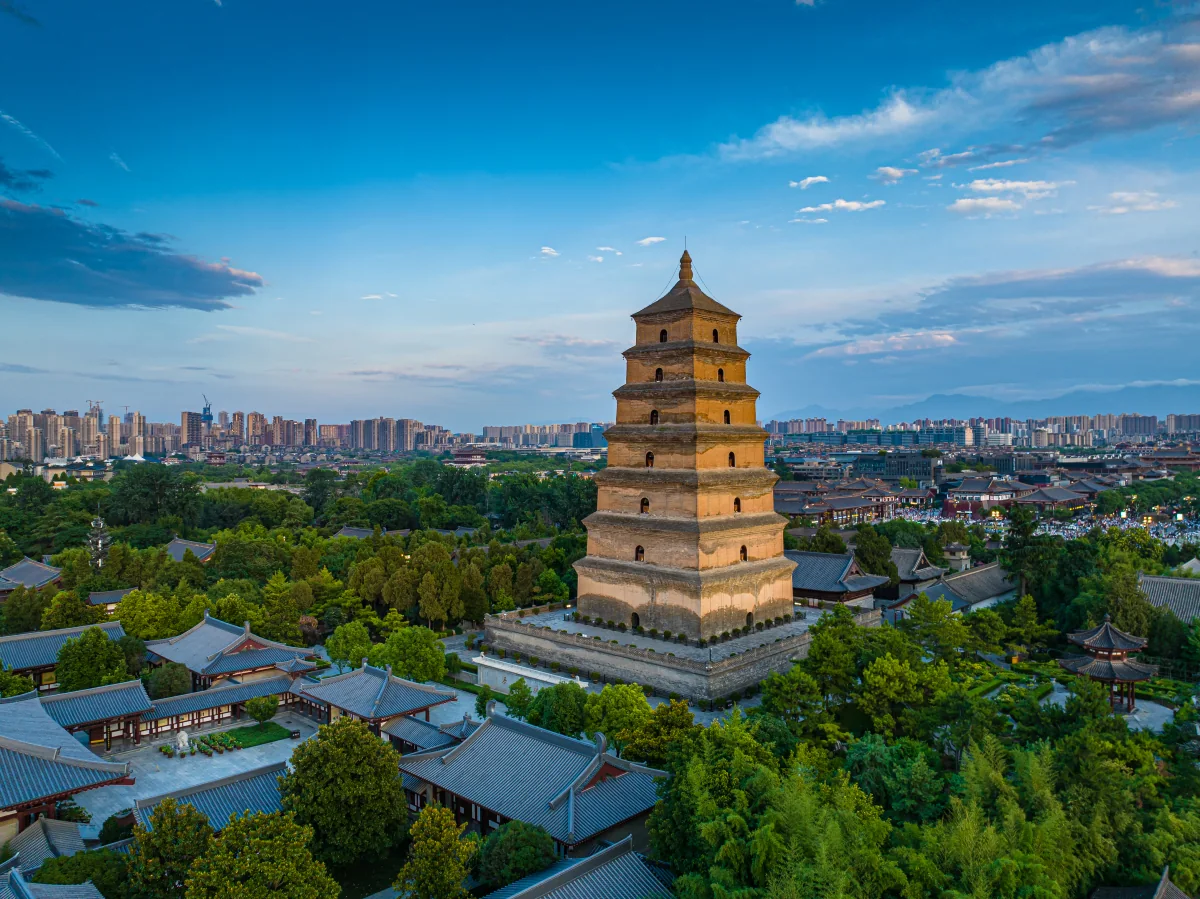
| # | Stop | Cost | Getting there |
|---|---|---|---|
| 1 | Shaanxi History Museum (or Xi’an Museum) | Free (both) — reservation required | Line 2/3 Xiaozhai Stn |
| 2 | Da Ci’en Temple + Big Wild Goose Pagoda | Temple $6 (¥40–50); climbing the pagoda $4.50 (¥30) | Line 3/4 Dayanta Stn |
| 3 | Tang Paradise (or hanfu portraits) | Paradise $18 (¥120); portraits ~$15–30 rental+shoot | Line 4 Datang Furongyuan Stn |
| 4 | Departure | — | Line 2 to North Station, or Line 14 to the airport |
How the day flows: The Shaanxi History Museum (陕西历史博物馆) is free and arguably China’s best provincial collection — Tang murals, the Hejiacun hoard of gold and silver — but it’s “the hardest reservation in Xi’an.” Tickets are released 5 days ahead at 17:00 sharp on the official WeChat account, and gone within minutes. Foreigners can reserve with a passport; if you strike out, the two backups are both excellent: Xi’an Museum (西安博物院) (beside the Small Wild Goose Pagoda — free, quieter, lovely grounds) or the Shaanxi Archaeology Museum (free, 3-day-advance booking, state-of-the-art displays). After the museum, circle back to Da Ci’en Temple (大慈恩寺): the yard the Big Wild Goose Pagoda stands in. The pagoda itself is a working Buddhist temple founded in 648 AD to house sutras Xuanzhang carried back from India — climbing it (extra ¥30 ticket, steep stairs, no elevator) buys you the best rooftop view of the city grid inside its walls. Then choose your finale: Tang Paradise (大唐芙蓉园) is a rebuilt imperial garden park — by day it’s pleasant, by night the lake-and-lantern scene is the closest Xi’an gets to a Tang Disneyland; the photo crowds go for hanfu rental and portraits in the alleys just west of the pagoda instead (book 1–2 days ahead for weekend slots at the popular studios). End where you started: the airport run needs Line 14 from the North Station, about 60–75 minutes door-to-door.
How much do Xi’an’s attractions cost?
| Attraction | Price (2026 reference) |
|---|---|
| Terracotta Army | ¥120 (~$18) — passport reservation required |
| Xi’an city wall | ¥54 ( |
| Bell + Drum Tower combo | ¥50 (~$7.50); exteriors free |
| Huaqing Palace | ¥120 ( |
| Da Ci’en Temple (Big Wild Goose Pagoda yard) | ¥40–50 ($6–7); pagoda climb ¥30 (~$4.50) |
| Tang Paradise | ¥120 (~$18) |
| Shaanxi History Museum / Xi’an Museum / Archaeology Museum | Free — reservation required |
| Datang Everbright City, fountain show, Sajinqiao street | Free |
How do you get around Xi’an?
The metro — Lines 1/2/3/4/6/14 cover every stop in this itinerary. The verdict table:
| Mode | Verdict | Detail |
|---|---|---|
| Metro | Best default | Lines 1/2/3/4/6/14 cover every stop in this itinerary. Line 2 runs Bell Tower ↔ North Station ↔ (change) airport; Line 1 hits Sajinqiao; Lines 3/4 hit the Dayanta cluster |
| Tourist bus to the warriors | Morning only | Direct buses from near the Bell Tower or the North Station fill up by 09:00; metro+bus (Line 9 → Huaqingchi → 602/613) is the reliable fallback |
| Taxi / ride-hailing | Fine off-peak | The Zhonglou and Dayanta areas gridlock at rush hour and weekend nights — metro beats a cab almost always inside the walls |
| Airport | Line 14 | Xianyang airport ↔ North Station in ~40 min; a cab is 40–60 min and $15–20 (¥100–130) |
Payment note: street stalls and bus fare lean on mobile pay — set up Alipay/WeChat Pay with your foreign card before arrival (see our payments guide).
Where should you stay in Xi’an?
Near the Bell Tower — Line 2 under your feet, the Muslim Quarter at your doorstep. Three bases compared:
| Area | Best for | Why |
|---|---|---|
| Bell Tower / Muslim Quarter (inside the walls) | First-timers, food focus | The recommended base of this itinerary: Line 2 under your feet, Sajinqiao at breakfast distance, the wall’s South Gate one stop away. Noise-sensitive? Pick a lane-side hotel, not a main-street one |
| South Gate / Yongningmen | The wall experience | Sleep within sight of the ramparts; sunset entry is a 5-minute walk. Slightly quieter than Zhonglou, still metro-easy |
| Dayanta / Qujiang (south) | Night photography, families | Steps from the light city, Tang Paradise and the pagoda; the fountain show is your evening neighborhood show. Farther from the Muslim Quarter food scene |
What should you know before you go?
Reserve ahead — it’s the #1 mistake in Xi’an. The rest:
- Reserve ahead — the #1 mistake in Xi’an. The warriors (official account, passport number), Shaanxi History Museum (5 days ahead, 17:00 release), and prime wall sunset slots all book out, especially weekends and Golden Week (Oct 1–8). Re-check everything right before departure — schedules shift with the season.
- Best months: late March–May and September–early November. Summer is 35°C+ on unshaded ramparts; winter is cold but the light city and museum queues shrink dramatically. Autumn’s morning-evening spread is wide — pack layers.
- Legs, not luck: this itinerary walks 15–20k steps a day. The wall ride alone is 14 km on a heavy single-speed bike.
- Respect the Huizu quarters: the Muslim Quarter and Sajinqiao are living Hui communities — don’t bring outside food into halal shops, and ask before photographing people at work.
- Currency note: conversions here use ~¥6.7 = US$1 (Sept 2026); card rates will differ slightly.
Related reading: the full Xi’an food guide — what to order at Sajinqiao and how to eat the Muslim Quarter without the tourist markup.
Background reading: Terracotta Army and Xi’an City Wall — Wikipedia (accessed Sept 2026).
Practical facts checked against official sources
- Emperor Qinshihuang’s Mausoleum Site Museum (Terracotta Army) — reservations and tickets: bmy.com.cn
- Xi’an Metro — lines and fares: Xi’an Metro (Wikipedia, updated monthly)
- Shaanxi History Museum — free timed reservations: sxhm.com
Common questions
Is 3 days enough for Xi'an?
Yes — 3 days covers Xi'an's essentials if you cluster by direction: Day 1 inside the walled old town (Sajinqiao food street, Bell and Drum Towers, sunset bike on the 13.74 km Ming wall); Day 2 the Terracotta Army as a morning day-trip 40 km east, back for the 19:00 or 21:00 Big Wild Goose Pagoda fountain show and the Datang Everbright City light district; Day 3 the Shaanxi History Museum (or Xi'an Museum backup), Da Ci'en Temple and Tang Paradise. Add a 4th day only for Huaqing Palace with the Song of Everlasting Sorrow show, or Mount Hua.
Can foreigners book Terracotta Warriors tickets, and how?
Yes — foreign visitors can book the ¥120 (about US$18) ticket using a passport number on the Emperor Qinshihuang's Mausoleum Site Museum's official channels (official WeChat mini-program or the on-site ticket counter with your original passport), and enter by showing that same passport. Book several days ahead for weekends and Chinese holidays; tickets are date- and time-slotted. Third-party platforms (Trip.com, GetYourGuide) also resell entry, sometimes bundled with transport or a guide — worth it if you want the direct tourist bus from the city. The ticket includes the shuttle to the unexcavated mausoleum mound park across the road.
Can you bike the Xi'an city wall, and what does it cost?
Yes — the full Ming-dynasty circuit is 13.74 km and takes 90–120 relaxed minutes on the single-speed bikes rented on the wall (¥45/US$7 for 3 hours plus a refundable ¥100 deposit; six rental points including the South Gate/Yongningmen). Wall entry is ¥54 (US$8). Go 60–90 minutes before sunset from the South Gate: you ride into the blue hour and finish under the city lights. Summer afternoons on the unshaded ramparts are brutal; the wall stays open into the evening (seasonally to around 21:00–22:00) — confirm same-day hours on the official WeChat account.
How do you get Shaanxi History Museum tickets (the 'hardest reservation in Xi'an')?
Admission is free but capped: tickets are released 5 days in advance at 17:00 sharp (17:30 for the Qinhan branch) on the museum's official WeChat account, and gone within minutes — set an alarm for 16:57. Foreigners book with a passport number. If you miss it, two strong backups are also free: Xi'an Museum beside the Small Wild Goose Pagoda (quieter, lovely grounds, easier reservation) and the Shaanxi Archaeology Museum (3-day advance booking, modern displays). All three close Mondays.
Muslim Quarter or Sajinqiao — where should you actually eat in Xi'an?
Eat on Sajinqiao; walk Beiyuanmen for the atmosphere. Beiyuanmen (the lantern-strapped street from the Drum Tower) is the tourist edition of the Hui quarter — 30–50% markup and queue-bait snacks. The lanes one block in (Xiyangshi, Dapiyuan) and the street one metro stop north (Sajinqiao, Line 1 Sajinqiao Stn) are where Xi'an actually eats: Liu Xin paomo, Ma Er sour-soup dumplings, Li Weiyi hulatang and the morning zenggao sellers all live there. Rule of thumb: same dish, half the price, better version — walk 5 extra minutes.