What Can You Do in Harbin in 3 Days?
Published 2026-09-23 · Updated 2026-10-26 · Itineraries
TL;DR
A: Three days is right for Harbin if you commit to one season: winter (late Dec–Feb) runs Day 1 the old town, Day 2 the Ice and Snow World plus Sun Island, Day 3 a Yabuli ski day trip. Summer swaps the ice for architecture, the Songhua River and Sun Island greenery. Ride Metro Line 2 everywhere, book the ice park online, and pack real cold-weather gear — summer visitors find no ice at all.
What’s the short answer?
Harbin is two cities in one — a Russian-built old town you can walk, and a winter-only ice festival you must time your trip around. That split is why most plans fail: visitors arrive in July expecting ice sculptures and leave disappointed. This 3-day route commits to one season. In winter it runs Day 1 the old town (Central Street, Saint Sophia, the Chinese Baroque block), Day 2 the snow sights (Ice and Snow World + Sun Island), Day 3 a Yabuli ski day — every stop on Metro Line 2 except the ski run. In summer, swap Day 2 for riverfront and architecture and skip the ice entirely.
Why does this Harbin route work?
Most Harbin plans cram both seasons into one visit and end up seeing neither well. This one follows the city’s real geography:
- Day 1 walks a single line through the old town — Central Street to Saint Sophia to Laodaowai — all walkable or one short metro hop.
- Day 2 stays north of the river in Songbei, where Metro Line 2 strings the Ice and Snow World and Sun Island onto one line.
- Day 3 is a one-day rail trip to Yabuli, so you ski and return the same evening without moving hotels.
Day 1 — What are the Russian old town’s landmarks and food streets?
| # | Stop | Cost | Getting there |
|---|---|---|---|
| 1 | Central Street | Free | Metro Line 2, Central Street Stn |
| 2 | Flood Control Monument & Songhua River | Free | Walk north from Central Street |
| 3 | Saint Sophia Cathedral | Inside paid — check official channel for current price | 10-min walk from Central Street |
| 4 | Laochujia (guo bao rou birthplace) | ~¥70–90 (about $10–13) | Metro Line 2 to Shangzhi St, walk |
| 5 | Laodaowai Chinese Baroque Block | Free | Metro Line 3, Chinese Baroque Stn |
| 6 | Qiulin for red sausage & bread | ~¥65 (about $9) | Metro Line 1/2 to Orthodox Church area |
How the day flows: Start on Central Street, Harbin’s cobbled pedestrian spine of European façades, and walk to the river monument. Saint Sophia’s square is the photo stop (the interior art hall closes Mondays). Lunch at Laochujia for the original sweet-and-sour guo bao rou, then cross to Laodaowai’s restored Baroque lanes for old-name snacks. Finish at Qiulin to buy vacuum-packed red sausage and da lie ba bread — the proper souvenirs.
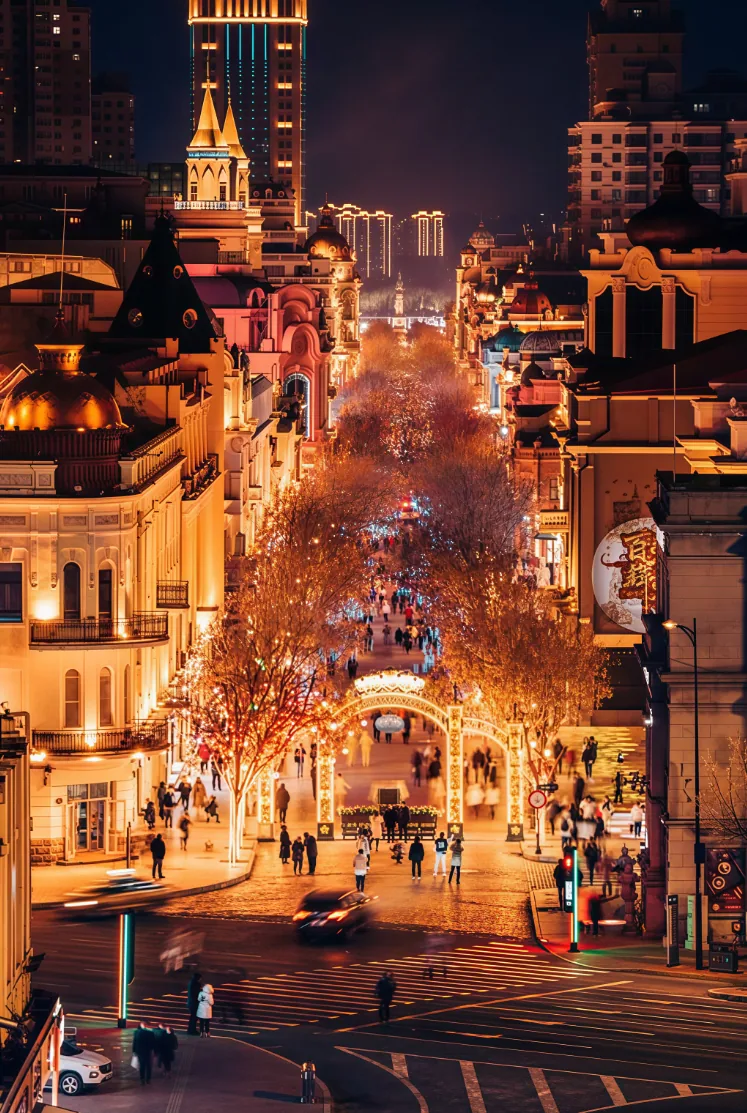
Three local shortcuts most visitors miss:
- Saint Sophia’s interior is a paid art hall that closes Mondays — go early, and photograph the exterior square for free if you’d rather skip the ticket.
- Buy red sausage and Russian bread at Qiulin (Li Daosi brand), not the “Russian specialty” shops on Central Street, which are mostly rebadged domestic goods.
- Laodaowai’s Zhang Baopu baozi (open since 1902) often sells out before 3pm — go at lunch, not as an after-dinner stop.
Day 2 — Where is the ice, and how do you see it without freezing?
| # | Stop | Cost | Getting there |
|---|---|---|---|
| 1 | Sun Island Snow Sculpture Expo | Tiered — check official mini-program | Metro Line 2, Sun Island Stn |
| 2 | Ice and Snow World | Tiered, released each season — check official WeChat mini-program | Metro Line 2, Ice and Snow World Stn (exit at the gate) |
| 3 | Zhaolin Park ice lanterns (winter) | Check on site; winter only | Metro Line 3, Zhaolin Park Stn |
How the day flows: Enter Sun Island in the afternoon for the giant snow sculptures, then walk or ride to the Ice and Snow World next door for the 18:00 light show — entering around 15:00–16:00 lets you see it in daylight and lit. The metro drops you at the gate; after closing, take the metro back, because taxis are nearly impossible to hail in the cold crush. Inside, food costs about double the city, so eat before you enter and carry a thermos.
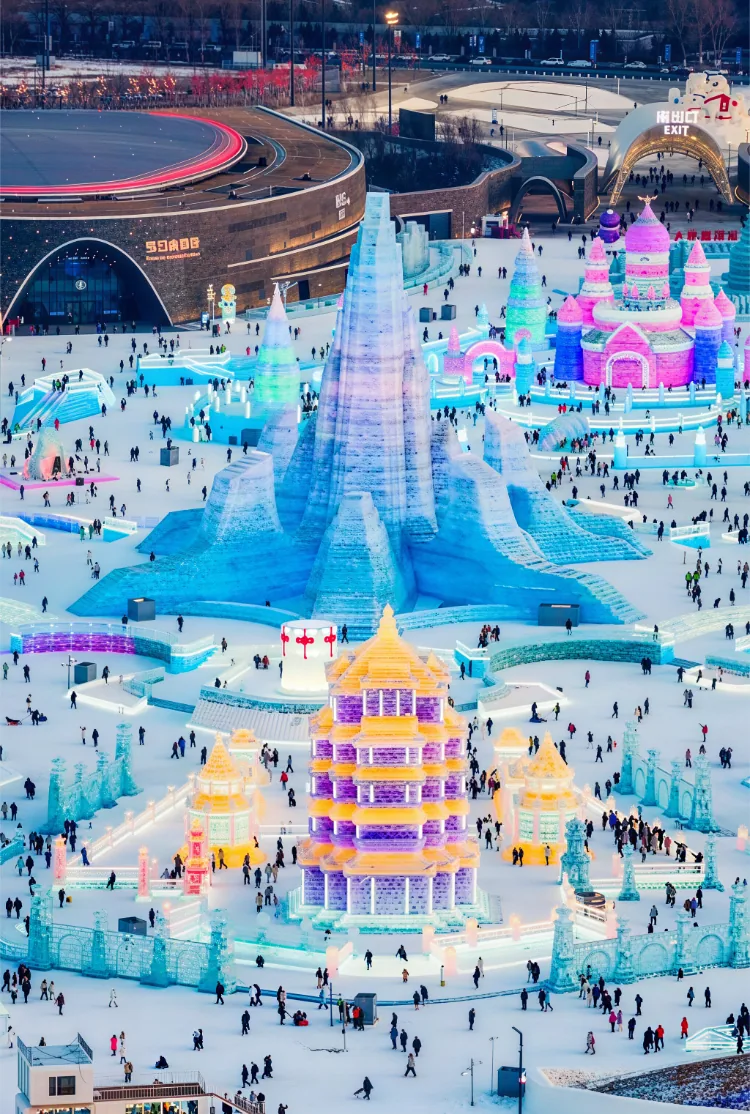
Three local shortcuts most visitors miss:
- The ice park is winter-only, roughly late December to end of February — summer visitors find no ice at all, so time flights around the season and verify the opening date on the official mini-program first.
- Dress in layers for −20 to −30°C: thermal base, fleece mid-layer, long down coat, face mask, two glove pairs, snow boots a size large, heat packs. Indoor venues are ~30°C warmer — peel off on entry.
- Phones die fast in the cold; keep a power bank in an inner pocket and slip it against your body between shots.
Day 3 — Can you ski at Yabuli and be back for dinner?
| # | Stop | Cost | Getting there |
|---|---|---|---|
| 1 | Harbin Station / Harbin West | — | Metro Line 2 / Line 3 |
| 2 | Yabuli West (HSR) | 2nd class ~¥76–86 (about $11–12); verify on 12306 | D-train, ~1h03m–1h25m |
| 3 | Yabuli ski resorts | Lift/rental varies; check resorts | Shuttle bus from station, ~30 min |
| 4 | Return to Harbin | Same fare | Evening HSR |
How the day flows: A D-train from Harbin reaches Yabuli West in just over an hour; a resort shuttle meets you for 4–6 hours of skiing, then an evening train returns you to the city. It is a full but realistic day trip — no hotel change needed. Winter weekend seats sell out, so book on 12306 ahead.
Three local shortcuts most visitors miss:
- Trains to Yabuli leave from Harbin Station or Harbin West, not Harbin East — double-check “Harbin” vs “Harbin West” when buying.
- Snow Town is a different trip: the drive is ~5 hours, so a same-day return is unrealistic — stay one night (outside the scenic core is cheaper and quieter) if you go.
- The 731 Site museum is free but reservation-only and emotionally heavy; pair it with the Harbin Grand Theatre only if you want a city-deep Day 3 instead of skiing.
What to eat in Harbin (and where)
Harbin food is Dongbei (Northeast) comfort cooking with a Russian accent — big portions, sweet-and-sour notes, and red sausage, bread and borscht folded into daily life.
- Laochujia — the 1907 birthplace of guo bao rou (sweet-and-sour pork); order the original vinegar-sugar version, not the ketchup style. ~¥70–90.
- Madier Western Restaurant — Russian borscht, pan-fried mahi-mahi and beef stew; on Central Street since 1906. ~¥150.
- Zhang Baopu — century-old baozi with whole pork ribs inside; Laodaowai, cheap and local. ~¥52.
- Laodingfeng — old-name pastries and ice cream; the childhood souvenir and a cheap eat. ~¥26.
- Qiulin (Li Daosi) — buy red sausage, da lie ba bread and kvass to take home; vacuum packs keep ~15 days.
Sweet stop: a Madier ice pop (about ¥5, about $0.70) from the open window on Central Street — eating it at −20°C is the local ritual.
Practical notes
Payment: Alipay and WeChat Pay cover nearly everything (street food, metros, ferries). Link a foreign card before you fly — see our payments guide.
Reservations: The Ice and Snow World and Sun Island Snow Expo are real-name, online reservation only — there are no valid scalper tickets at the gate. The Heilongjiang Provincial Museum and the 731 Site are free but reservation-only and closed Mondays. Saint Sophia’s interior also closes Mondays.
Transport: The metro (Lines 1/2/3) is the backbone; Line 2 alone links the ice park, Sun Island, Central Street, Saint Sophia, Harbin Station and the museum. There is no airport metro — use the airport bus (about ¥20, several lines including one to Central Street and one to Songbei/Ice Park) or a taxi (about ¥100–150, longer in ice). The Songhua River ferry stops in winter when the river freezes. DiDi has an English interface and takes cards; short hops are easier by metro in the cold.
Avoid: roadside “fast-track / internal ticket” touts at the ice park are scams (everything is real-name). Taxi-driver “recommended” restaurants often pay kickbacks — use a review app.
More planning help: Harbin destination page, the Northeast China autumn guide, Dalian 3-day itinerary, the 12306 train guide, the payments guide, hotels that accept foreign passports, and the eSIM guide.
Common questions
When does Harbin Ice and Snow World open?
It runs only in winter, roughly late December through end of February. Exact dates and ticket tiers are released each season — check the official WeChat mini-program before booking flights, because summer visitors will find no ice sculptures at all.
What should I pack for a Harbin winter?
Layer for −20 to −30°C: a thermal base, fleece or wool mid-layer, and a long down coat; add a face mask, two glove pairs (thin touchscreen + thick waterproof), snow boots a size large, and heat packs. Indoor venues are about 30°C warmer, so peel layers on arrival.
When is the best time to visit Harbin?
Winter (Dec–Feb) for the ice festival and snow photography; summer (Jun–Aug, around 23°C) for Russian architecture, the Songhua River and Sun Island without ice. They are effectively two different trips, so plan around one season.
Can I ski at Yabuli as a day trip from Harbin?
Yes. High-speed trains from Harbin reach Yabuli West in about 1h03m–1h25m (second class about ¥76–86; verify on 12306). Ski 4–6 hours, then return by evening train. Book ahead — winter weekend seats sell out.
How do I get around Harbin?
The metro (Lines 1/2/3) is the backbone; Line 2 alone links the Ice and Snow World, Sun Island, Central Street, Saint Sophia, Harbin Station and the museum. There is no airport metro line — use the airport bus (about ¥20) or taxi. After the ice park closes, take the metro; taxis are nearly impossible to hail.
How many days do I need in Harbin?
One day covers Central Street, Saint Sophia and the Ice and Snow World; three days lets you add Sun Island or a Yabuli ski day. The city's own guidance suggests 1–2 days for the core, more if you head to Snow Town or Yabuli.
Sources
- 12306 — official China Railway ticketing platform — operator · accessed 2026-10-26
- 12306 — official English FAQ (endorsement and refund rules) — operator · accessed 2026-10-26